

How to Hire a Financial Analyst: Interview Questions, Skills, and a 30-60-90-Day Plan

To hire a financial analyst, define the business decisions the role will support, identify the skills those decisions require, and evaluate candidates through structured interviews and a realistic work sample. Then establish a 30-60-90-day plan that connects the new hire’s work to your finance team’s priorities.
That sounds straightforward. The harder part is deciding what your company actually needs.
One organization needs someone who can bring discipline to forecasting. Another needs better visibility into margins. A third needs an analyst who can sit down with department leaders, challenge assumptions, and explain why the numbers have changed.
Those needs can all sit behind the same job title. They should not produce the same search.
For CFOs, finance leaders, HR executives, and hiring managers, a successful financial analyst hire starts with clarity about the work—not a recycled job description.
Start With the Business Problem, Not the Job Title
Before opening the position, ask a practical question: What should this person help us understand or do better?
“Support the finance team” is not a useful answer. Neither is “own reporting.” Both leave too much room for disagreement about what success looks like.
A more effective hiring brief identifies a few concrete outcomes:
- Improve the reliability of the revenue forecast.
- Explain the operating drivers behind margin changes.
- Give department leaders more useful budget-to-actual reporting.
- Reduce manual work in recurring management reports.
- Build a consistent process for evaluating headcount or capital requests.
These priorities help determine whether you need an early-career analyst, an experienced individual contributor, or a senior financial analyst who can work independently with business leaders.
Clarify Which Kind of Financial Analyst You Need
For this guide, “financial analyst” means a corporate finance or financial planning and analysis role—not an investment research position or personal financial advisor.
Even within corporate finance, the scope can vary considerably. Use the following framework to define your opening.
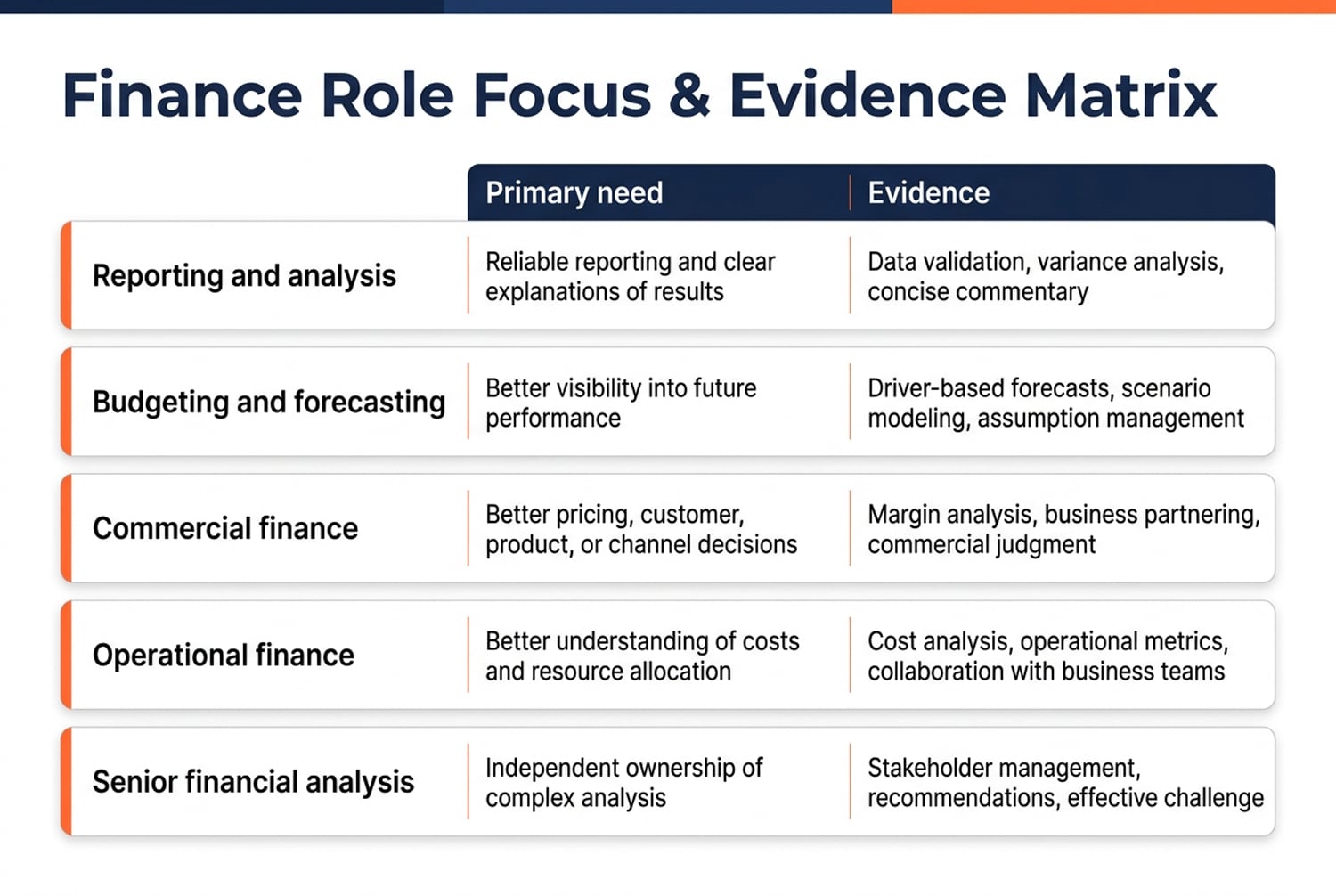
Treat this as a planning tool rather than a universal classification system. The right scope depends on your organization.
Build a Financial Analyst Job Description Around Outcomes
A job description should give qualified candidates enough information to recognize the opportunity—and decide whether it fits.
Start with a short explanation of why the role exists. Follow it with the work the person will own, the people they will support, and the experience they need to contribute.
For example:
This financial analyst will support monthly forecasting, investigate revenue and expense variances, and help department leaders understand the financial impact of operating decisions. During the first six months, the analyst will take ownership of recurring management reporting and recommend improvements to the forecasting process.
That description says more than a long list of broad responsibilities.
Include:
- Reporting relationship and team structure.
- Primary deliverables and recurring deadlines.
- Business units or departments supported.
- Expected level of independence.
- Relevant systems and analytical tools.
- Location, work arrangement, and travel expectations.
- Compensation and benefits information appropriate to the posting.
Separate requirements from preferences. If experience with your exact planning platform is helpful but teachable, say so. Otherwise, you risk screening out someone with stronger analytical judgment who has used a comparable system.
Financial Analyst Skills: What to Evaluate Beyond Excel
Spreadsheet proficiency matters, but it should not become a substitute for evaluating how someone thinks.
Build your assessment around these six capabilities.
1. Financial and Accounting Fundamentals
Candidates should understand the financial relationships relevant to the role.
Can they distinguish revenue growth from profitable growth? Explain why a favorable expense variance may not be good news. Recognize when timing differences affect comparisons?
For a role supporting forecasts or management reporting, ask candidates to connect financial statements, operational activity, and business performance—not simply define terms.
2. Financial Modeling and Forecasting
Look for models that make assumptions visible and are practical to maintain.
Ask how candidates:
- Identify the drivers behind a forecast.
- Separate assumptions from calculations.
- Build scenarios without creating unnecessary complexity.
- Check whether outputs are reasonable.
- Update a model when business conditions change.
The goal is not to find the most elaborate spreadsheet. It is to find someone whose work another person can understand, review, and use.
3. Data Quality and Systems Fluency
Give candidates an opportunity to explain how they validate information before analyzing it.
A strong response should describe a process: checking definitions, reconciling totals, investigating missing values, and confirming the reporting period.
Evaluate tools in context. Excel, business intelligence platforms, enterprise resource planning systems, and planning software may all matter, but the requirement should reflect the actual work.
4. Business Judgment
Analysis becomes useful when it changes a decision.
Ask candidates to explain how they distinguish a meaningful issue from ordinary variation, prioritize competing requests, and decide when they have enough information to recommend a next step.
Listen for appropriate uncertainty. An analyst who acknowledges a weak assumption may demonstrate better judgment than one who presents an unsupported conclusion with confidence.
5. Communication and Business Partnering
A technically correct answer can still fail if the audience cannot understand it.
Ask candidates to explain a financial issue twice: first to the finance team, then to a department leader without a finance background.
Look for clear language, relevant context, and a recommendation proportionate to the evidence.
6. Responsible Use of Automation and AI
If the role will use automation or approved AI tools, assess how the candidate checks the results.
Useful questions include:
- What information would you avoid entering into an unapproved tool?
- How would you verify an AI-generated formula or explanation?
- What controls would you keep around an automated report?
- When would you stop using a tool and investigate the underlying data yourself?
Treat these as judgment questions, not a test of enthusiasm for technology. Familiarity with a tool does not establish that someone can use it responsibly.
Financial Analyst Interview Questions That Reveal How Candidates Think
Use a consistent set of core questions and a common scoring framework.
The U.S. Office of Personnel Management describes structured interviews as assessments built around job-related competencies, with candidates answering the same predetermined questions and being evaluated against the same standards. That framework provides a useful foundation for a more disciplined hiring process.opm
The following questions are suggested starting points. Adapt them to your role.
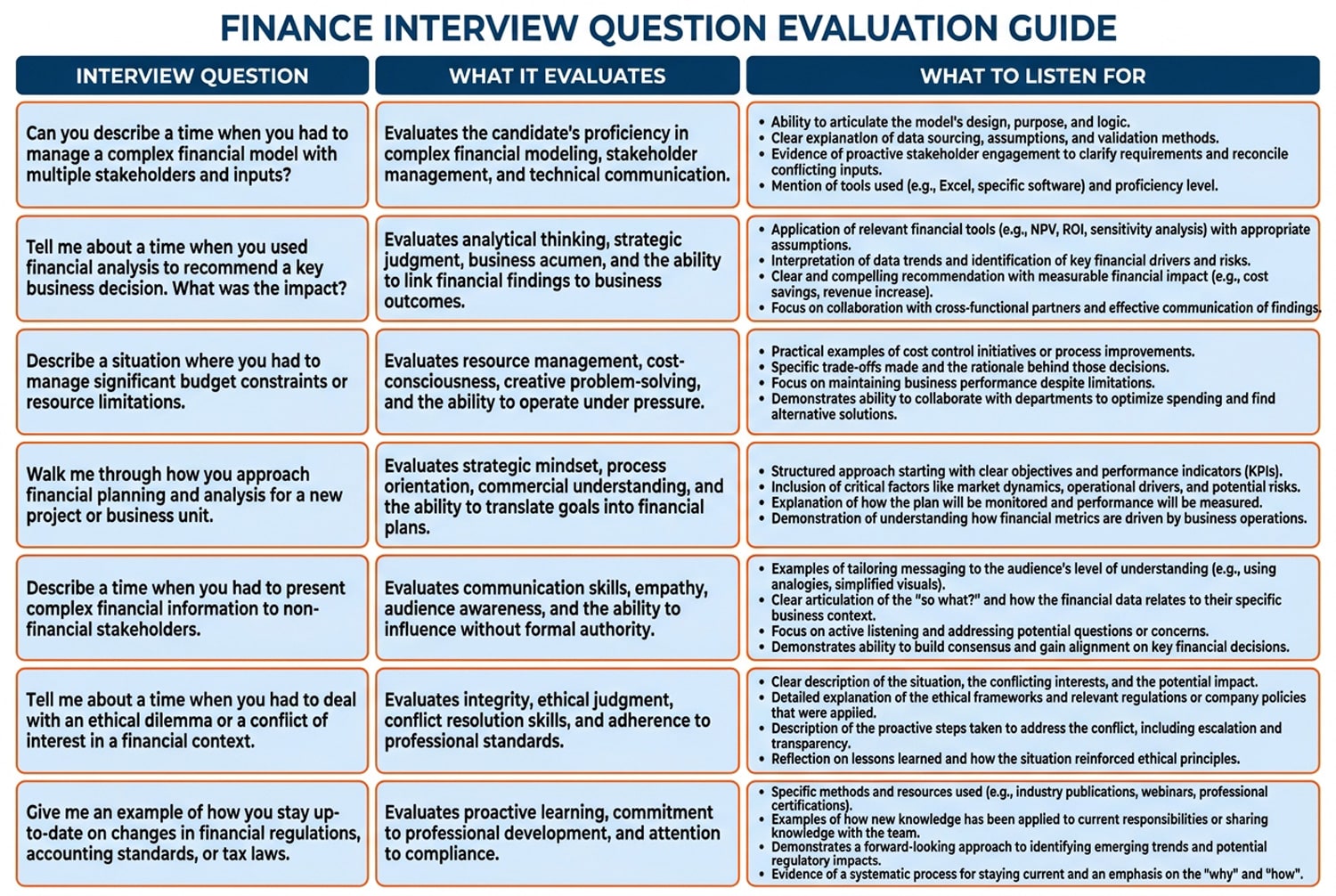
Use a Simple Evaluation Scorecard
Before interviews begin, agree on what each competency means at the level you are hiring.
A proposed five-point scale might run from “cannot yet perform this work” to “can independently handle complex work and explain the reasoning.” Define the intermediate levels with observable examples.
OPM recommends developing rating scales around proficiency levels and behavioral or situational examples, rather than leaving interviewers to interpret scores independently.
Have interviewers record evidence before the debrief. “Strong candidate” is an impression. “Identified three plausible margin drivers, described how to test each, and acknowledged the limits of the data” is evidence.
Add a Short, Realistic Financial Analyst Work Sample
An interview shows how a candidate describes their work. A work sample lets you observe their approach.
For a corporate finance role, consider a small fictional dataset containing:
- Budget and actual results for several months.
- Revenue, expense, and operating metrics.
- A few clearly stated business assumptions.
- One or two data issues worth investigating.
Ask candidates to identify the most important variances, explain possible drivers, and prepare a brief recommendation for a non-finance leader.
Keep the exercise proportionate. A suggested format is a 45–60-minute assessment using fictional or anonymized information—not an unpaid project your company needs completed.
Tell candidates in advance:
- How much time to spend.
- Which tools are permitted.
- Whether AI assistance is allowed and must be disclosed.
- What deliverables you expect.
- How you will evaluate the work.
Score accuracy, reasoning, communication, and assumption handling separately. Leave time for candidates to explain their approach; the discussion may reveal more than the finished spreadsheet.
Make the Hiring Decision Against the Role You Defined
At the final debrief, return to the business outcomes established at the beginning.
Can this candidate perform the work at the required level? Where will they need support? Is that support realistically available?
Watch for three common decision traps:
- Choosing presentation polish over analytical substance.
- Overvaluing experience with a specific software platform.
- Hiring for a more senior role than the budget, authority, or responsibilities actually support.
References can help test remaining questions. With appropriate candidate permission, ask about the person’s ownership of analysis, responsiveness to feedback, and effectiveness with business partners.
Specialized recruiting support can also be valuable when the hiring team needs help calibrating the role, reaching relevant candidates, or separating closely matched finalists. The purpose is not simply to produce more resumes. It is to improve alignment between the business need and the person selected.
A Financial Analyst 30-60-90-Day Plan
The hiring process should establish expectations that carry into onboarding.
The following is a suggested framework. Adjust it for seniority, reporting cycles, systems access, and the complexity of the business.
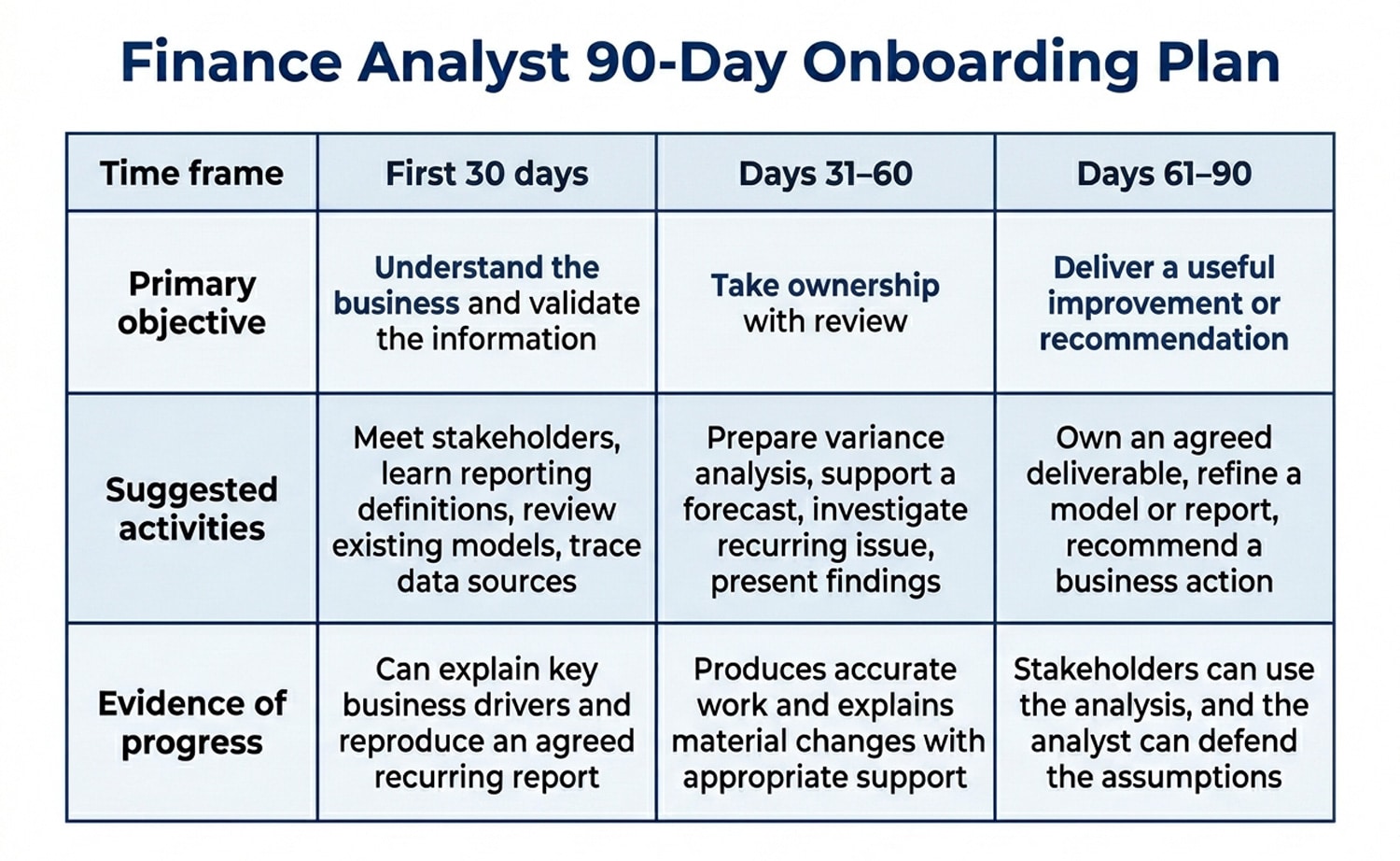
First 30 Days: Learn Before Redesigning
Give the new hire access to the people, systems, and documentation required to understand the business.
Ask them to learn why existing processes work as they do before recommending changes. A report that appears redundant may serve a control, customer, or operational purpose that is not immediately obvious.
Days 31–60: Establish Reliable Ownership
Choose a manageable recurring responsibility and define the review process.
For an early-career analyst, this may mean preparing a departmental variance analysis with close guidance. For a senior analyst, it may mean leading a forecast discussion and identifying decisions requiring attention.
Days 61–90: Connect Analysis to Action
By this stage, ask the analyst to demonstrate how their work supports a decision.
That might be a clearer explanation of customer profitability, a revised assumption in the forecast, or a reporting improvement that gives managers more useful information.
Set expectations around useful progress—not an arbitrary promise that every analyst should transform finance in three months.
Hire for the Decisions Ahead
The best financial analyst for your company is not necessarily the candidate with the longest tool list or the most polished interview style.
It is the person who can work with your data, understand your business, question assumptions thoughtfully, and communicate what leaders need to know. A clear role definition, consistent evaluation process, and practical onboarding plan make that person easier to recognize.
Oggi Talent helps employers recruit finance and accounting professionals, including financial analysts. If your team is preparing to hire, connect with Oggi Talent to discuss the role, the business priorities behind it, and the experience your next analyst needs to bring.
Frequently Asked Questions About Hiring a Financial Analyst
What qualifications should I look for when hiring a financial analyst?
Look for financial knowledge, analytical ability, modeling skills, and clear communication relevant to the position. A bachelor’s degree in finance, business, or a related field is a common entry qualification, according to the U.S. Bureau of Labor Statistics. Evaluate candidates’ work and reasoning alongside their credentials rather than relying on education alone.
What are the best interview questions for a financial analyst?
Ask candidates to explain a forecast miss, investigate a margin change, reconcile conflicting reports, and describe how their analysis influenced a decision. Use the same core questions and scoring criteria for each candidate. This follows the structured-interview approach of evaluating job-related competencies consistently.
How do you assess a financial analyst’s technical skills?
Use a short, job-relevant work sample with fictional data. Ask the candidate to review results, identify important variances, explain assumptions, and present a recommendation. Define tool-use rules and evaluation criteria in advance, then discuss the work to assess reasoning as well as spreadsheet accuracy.
What is the difference between a financial analyst and an FP&A analyst?
The titles can overlap. In a corporate finance hiring process, an FP&A analyst title typically signals a focus on planning, budgeting, forecasting, and performance analysis. “Financial analyst” may describe similar work or a different analytical specialty. Define responsibilities explicitly rather than assuming candidates will interpret the title the same way.
What should a financial analyst accomplish in the first 90 days?
A practical goal is to understand the business, validate key data sources, take ownership of an agreed deliverable, and produce a useful recommendation. Adjust expectations for experience and role complexity. An early-career analyst may need close review, while a senior analyst may be expected to lead discussions and own more complex analysis.