

How to Build a Finance Hiring Scorecard That Reduces Bad Hires

A polished résumé can tell you where a finance candidate has worked. It cannot tell you whether that person can shorten your month-end close, earn the CEO’s trust, lead an overstretched accounting team, or explain a difficult forecast to the board.
That is the problem a finance hiring scorecard is designed to solve.
A scorecard gives everyone involved in a search the same definition of success. Instead of asking whether a candidate “seems like a strong CFO” or “feels right for the team,” the hiring group evaluates evidence against the work the person will actually need to do.
For a Controller, that may mean strengthening controls and reporting. For a VP of Finance, it may mean building a dependable planning process. For a CFO, it may mean guiding capital decisions while developing the finance leadership team. The title alone does not tell you which capabilities matter most.
A finance hiring scorecard is a role-specific evaluation tool that connects business outcomes to interview questions, evidence, and consistent ratings. It cannot guarantee a successful hire. It can, however, surface gaps and disagreements before you make an offer.
Why Finance Hires Go Wrong
Many hiring mistakes begin before the first candidate is interviewed. The CEO wants a strategic partner. The CFO wants someone to stabilize reporting. HR has been asked to find a strong people leader. All three expectations may be reasonable, but they may not describe the same job.
If those priorities remain unspoken, each interviewer assesses a different candidate. One is impressed by public-company experience; another values hands-on systems work; a third prefers someone who communicates like the departing leader. By the final discussion, the team has plenty of opinions but little comparable evidence.
Finance roles are especially susceptible to this problem because their titles cover such different mandates. A Controller at one company may oversee a large accounting organization. At another, the Controller is the most senior finance professional and also handles budgeting, lender requests, and operational analysis.
A useful scorecard does not begin with a list of prestigious employers or preferred credentials. It begins with a more practical question: What must this leader accomplish here?
Structured assessment supports that approach. The U.S. Office of Personnel Management describes structured interviews as using predetermined, job-related questions and the same rating standards for every candidate. More recent guidance from the Chartered Institute of Personnel and Development (CIPD) recommends agreeing on scoring criteria in advance and having interviewers score independently before they discuss candidates.
Start With the First-Year Mandate
Before writing interview questions, ask the people closest to the role to describe what needs to change over the next 12 months.
Try to agree on three to five outcomes. For example:
- Reduce an unreliable close from 15 business days to eight.
- Introduce a rolling cash-flow forecast that operating leaders can use.
- Prepare the finance function for an audit or acquisition.
- Improve margin visibility across products, customers, or locations.
- Develop two managers who can take on broader responsibility.
These are examples, not universal targets. The right measures depend on the company’s starting point, resources, and growth plans.
Next, separate essential experience from learnable preferences. If a candidate must have led a multi-entity close, make that requirement explicit. If experience with one particular ERP would simply shorten the learning curve, do not automatically treat it as a deal-breaker.
This step makes the search more precise without closing the door on candidates who have solved similar problems in a different industry, system, or organizational structure.
Build a Finance Candidate Evaluation Template
A practical finance hiring rubric does not need to be complicated. For each competency, record the outcome it supports, the question or assessment used to test it, what strong evidence looks like, the rating, and the interviewer’s notes.
For example, a company hiring a Controller might use the following scorecard:
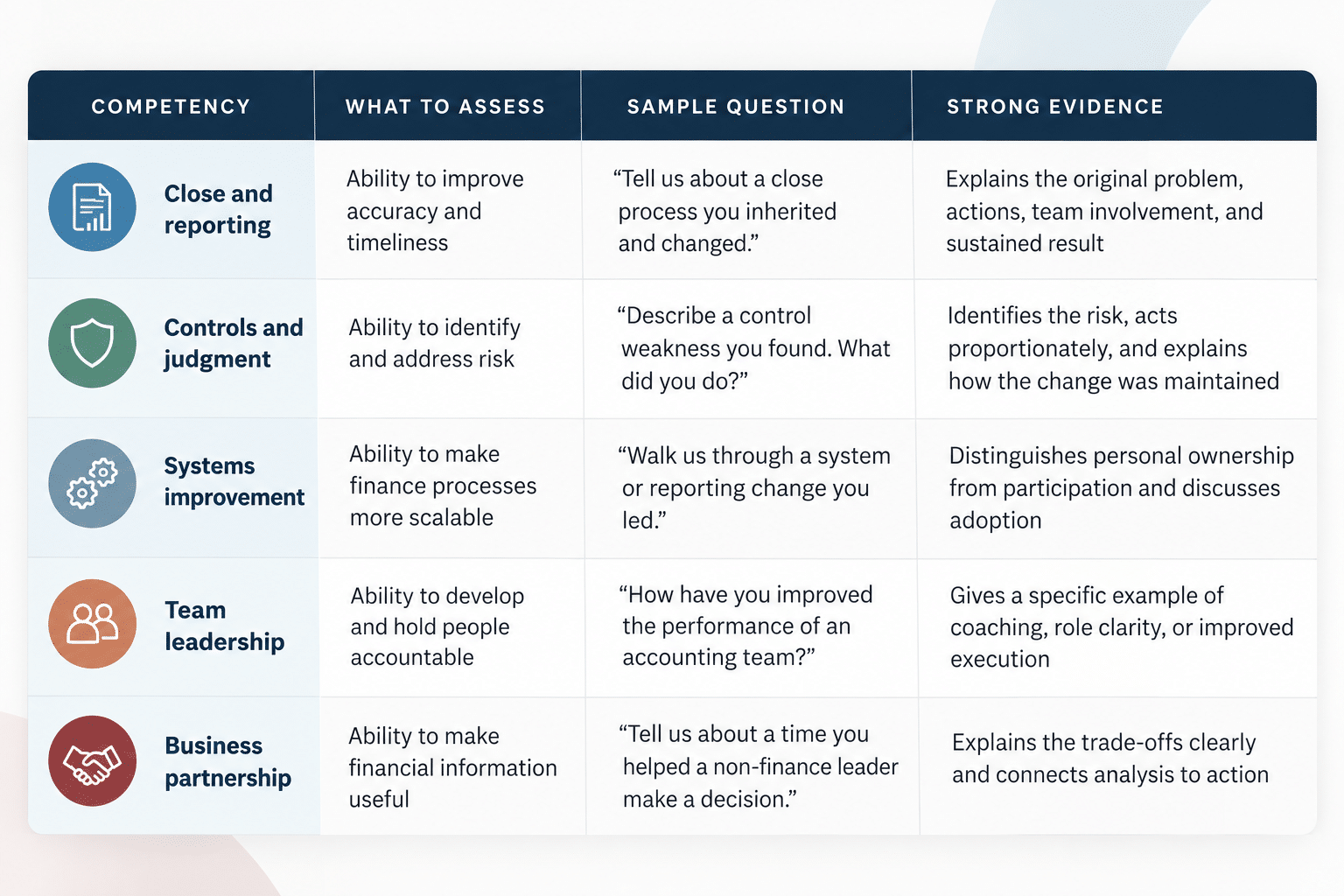
Give interviewers space to record what the candidate actually said. “Strong communicator” is an impression. “Explained a cash-flow shortfall to operations leaders, presented three options, and secured agreement on a revised inventory plan” is evidence.
Change the Scorecard With the Role
The structure can stay consistent across searches, but the criteria should change with the job.
For an accounting leadership hire, a scorecard may emphasize reporting, controls, audit readiness, technical judgment, and team management. For a VP of Finance, it may place more weight on forecasting, financial modeling, performance analysis, and partnership with operating leaders. A CFO scorecard may need to test capital allocation, CEO and board communication, risk judgment, financing, and the ability to build a finance function suited to the company’s next stage.
Do not copy a CFO scorecard into a Controller search and simply change the title. That can lead a company to overlook an excellent accounting leader because the interview focused on responsibilities the role will never own.
Likewise, a candidate can excel at technical accounting without demonstrating the strategic judgment required for a particular CFO position. The scorecard should make that distinction clear without diminishing either skill set.
Use a Rating Scale People Can Apply
A five-point scale is easy to use, provided the team defines what the numbers mean before meeting candidates:
1 — No relevant evidence: The answer does not demonstrate the required capability.
2 — Limited evidence: Some relevant exposure, but little direct ownership.
3 — Meets requirements: A credible example at the scope needed for the role.
4 — Strong evidence: Direct ownership with a clear, relevant result.
5 — Exceptional evidence: Repeated results in comparable or more complex settings, with sound judgment about what would transfer to this organization.
Use “not assessed” when an interviewer did not gather evidence. It is not the same as a low score.
Weights are optional. A company facing an imminent audit might place more emphasis on controls and technical accounting than on long-range planning. If you use different weights, decide them in advance and document why. OPM notes that equal weighting is generally the more defensible default when there is no clear rationale for weighting competencies differently.
Ask the Same Core Questions
A structured interview does not have to feel robotic. It means every candidate gets a fair chance to address the same essential requirements. Interviewers can ask follow-up questions to understand a response, while keeping the core assessment consistent.
For finance leadership roles, useful questions often focus on decisions rather than responsibilities:
- “Tell us about a forecast you got wrong. How did you recognize the issue, communicate it, and adjust?”
- “Describe a time you had to challenge an operating leader’s assumptions.”
- “What financial process did you improve, and how did you know the improvement lasted?”
- “Tell us about a time you had to balance speed with control.”
- “What did you change after receiving difficult feedback from a CEO, board member, or team member?”
These questions invite candidates to discuss context, personal contribution, trade-offs, and results. They also make it harder to mistake familiarity with finance terminology for experience doing the work.
A 2026 Forbes Advisor article argues that structured interview kits and scorecards can help hiring teams replace loosely comparable impressions with more consistent evidence.
Add a Small, Relevant Work Sample
For a finalist, a brief work sample can reveal how the candidate thinks. It should resemble a real part of the role, use fictional or appropriately anonymized information, and respect the candidate’s time.
A Controller candidate might review a short close-process scenario and identify the first three questions they would ask. A VP of Finance candidate might explain the most important risks in a simplified forecast. A CFO candidate might present options for funding a hypothetical expansion and describe what information they would need before making a recommendation.
Give each candidate the same instructions, time allowance, and evaluation criteria. Score the work on the reasoning and communication the job requires—not on whether the candidate guessed the answer the hiring team already had in mind. CIPD advises using skill-based tasks that resemble the work and, where possible, supporting interview findings with other relevant evidence.
Discuss Evidence Before Preferences
Ask interviewers to complete their scorecards independently before the debrief. Otherwise, the first person to speak—often the most senior person in the room—can unintentionally set the discussion’s direction.
Then compare the evidence competency by competency. Where ratings differ, ask what each interviewer heard and whether a follow-up could resolve the uncertainty. Do not average scores mechanically and assume the highest number wins. A scorecard is a decision aid, not a substitute for judgment.
It should also expose a poorly designed role. If every promising candidate falls short on the same unusual combination of requirements, revisit the mandate. The business may be trying to hire one person for two jobs.
Conclusion: Make the Decision Clearer
A good finance hiring scorecard gives a company a better way to decide. It ties the search to business outcomes, gives candidates a fair opportunity to demonstrate their strengths, and helps the hiring team distinguish proven capability from a persuasive interview.
That clarity matters most for consequential hires. When a finance leader will influence reporting, investment, risk, and the confidence of the broader leadership team, the company should know exactly what it is evaluating—and why.
Oggi Talent helps organizations define the real mandate behind finance and accounting leadership roles, reach qualified candidates, and evaluate fit with the work ahead. If your company is preparing to hire a Controller, VP of Finance, CFO, or other finance executive, Oggi Talent can help you build a focused search around the outcomes that matter most.
Frequently Asked Questions
What is a finance hiring scorecard?
A finance hiring scorecard is a role-specific tool for evaluating candidates against defined business outcomes and competencies. It records the questions or assessments used, the evidence gathered, and consistent ratings so the hiring team can compare candidates more fairly.
What should an accounting interview scorecard include?
An accounting interview scorecard should include the responsibilities that matter most for the job, such as close and reporting, controls, technical judgment, systems, and team leadership. Each area should have a relevant question, a description of strong evidence, a rating scale, and space for notes.
How do you score a finance candidate interview?
Agree on job-related criteria and rating definitions before interviews begin. Ask each candidate the same core questions, record specific evidence, and have interviewers score independently before discussing their assessments as a group.
Should a CFO and a Controller use the same hiring rubric?
No. Both roles may require financial judgment and leadership, but a Controller scorecard typically emphasizes accounting operations, reporting, and controls. A CFO scorecard should reflect the organization’s need for strategic leadership, capital decisions, risk management, and senior stakeholder communication.
Can a hiring scorecard prevent a bad hire?
No hiring tool can guarantee an outcome. A well-designed scorecard can reduce avoidable mistakes by clarifying expectations, exposing missing evidence, and helping interviewers assess candidates against the role’s actual demands rather than relying on impressions alone.
References
- U.S. Office of Personnel Management — Structured Interviews
- U.S. Office of Personnel Management — How Do I Score a Structured Interview?
- CIPD — Selection Methods
- Forbes Advisor Brand Group — The Hiring Mistakes That Burn Cash and How to Fix Them