

What Does a Staff Accountant Do? Skills, Salary Factors, and Career Growth

A staff accountant helps maintain accurate financial records by preparing journal entries, reconciling accounts, supporting month-end close, and investigating discrepancies. The role builds the foundation for reliable financial reporting and can lead to senior accountant, accounting manager, and other finance leadership positions.
But the title alone does not tell you everything.
At one company, a staff accountant might focus on cash reconciliations and recurring journal entries. At another, the same title could involve inventory accounting, multiple business entities, or regular conversations with department leaders.
For professionals considering their next move, those differences matter. The best opportunity is not necessarily the one with the most impressive title. It is the one that helps you develop stronger judgment, take ownership of meaningful work, and build experience that supports your career goals.
For employers, understanding those differences is equally important. A clearly defined staff accountant position is easier to recruit for, support, and develop.
What Does a Staff Accountant Do Day to Day?
Staff accountants help ensure that financial transactions are recorded correctly and that account balances can be explained and supported. Their work contributes to the broader accounting function, which includes maintaining financial records, examining their accuracy, and identifying financial risks or opportunities for improvement.
The exact responsibilities depend on the organization’s size, industry, systems, and division of work.
In a corporate accounting department, a staff accountant’s responsibilities may include the following.
Prepare Journal Entries
Journal entries record activity in the accounting system. A staff accountant may prepare entries for accrued expenses, prepaid expenses, depreciation, or other recurring transactions.
The task involves more than entering numbers. The accountant needs to understand the underlying transaction, use the appropriate accounts and reporting period, and retain supporting documentation.
For example, if a business has received a service but has not yet received the invoice, the accountant may need to record an accrued expense under the company’s accounting policies.
Reconcile Accounts
An account reconciliation compares a general ledger balance with supporting records and explains any differences.
For a cash account, that may involve comparing the ledger with a bank statement. For a prepaid expense account, it may mean comparing the recorded balance with a schedule showing how costs are recognized over time.
The goal is not simply to make two numbers match. It is to determine whether the balance is complete, accurate, and supported—and to investigate anything that does not belong.
Support Month-End Close
Month-end close is the process of finalizing accounting records for a reporting period.
A staff accountant may prepare assigned entries, complete reconciliations, review account activity, and respond to questions from a senior accountant or manager.
The scope can vary considerably. One role may own a small set of accounts. Another may involve several entities or a broader portion of the close.
Investigate Discrepancies and Explain Changes
Accounting work requires curiosity.
If an expense account increases unexpectedly, a staff accountant may need to determine whether the change reflects normal business activity, a timing issue, a coding error, or a missing entry.
Explaining what happened—and showing the evidence—is an important step beyond simply processing transactions.
Prepare Supporting Schedules and Documentation
Staff accountants may also help prepare schedules used for financial reporting, audits, or internal reviews.
Clear documentation makes work easier to review and gives other team members a reliable starting point. It also helps preserve continuity when responsibilities change.
Staff Accountant vs. Bookkeeper: What Is the Difference?
Bookkeeping and staff accounting responsibilities can overlap, particularly in smaller organizations.
Broadly, bookkeeping roles emphasize recording, classifying, and maintaining transaction data. Accounting roles extend into examining financial records, applying accounting principles, and evaluating financial information. The Bureau of Labor Statistics distinguishes these occupations while recognizing that both contribute to accurate records.
In practice, a staff accountant position may place greater emphasis on:
- General ledger reconciliations.
- Adjusting journal entries.
- Accrual accounting.
- Month-end close.
- Financial reporting support.
- Investigation of accounting issues.
Do not judge an opportunity by the title alone. Ask what the person actually owns, who reviews the work, and how much judgment the position requires.
A role called “staff accountant” that consists almost entirely of transaction entry may offer a different development path than one with meaningful close and reconciliation responsibilities.
Staff Accountant vs. Senior Accountant: What Changes?
The difference is usually less about completing an entirely different set of tasks and more about the complexity, independence, and accountability involved.
The following comparison is a practical guide, not a universal job classification.

Actual senior accountant positions can combine technical ownership with broader responsibilities. For example, an Oggi-listed senior property accountant role includes financial reporting, variance investigation, audit support, and collaboration with finance and operating leaders. That is one industry-specific example—not a requirement for every senior accountant position.
For someone seeking advancement, the useful question is: “What evidence would show that I am ready for the next level?”
What Skills Does a Staff Accountant Need?
Accuracy matters, but it is only part of the picture. The broader accounting profession also requires analytical ability, communication, organization, and the ability to examine financial information critically.
For a staff accountant, those capabilities show up in everyday work.
Accounting Fundamentals
You should understand how transactions affect the financial statements, why timing matters, and how accruals, prepayments, and other adjustments work.
Knowing which entry to copy from last month is not the same as understanding why the entry exists.
When reviewing an opportunity, look for a role that helps deepen that understanding rather than simply increasing transaction volume.
Spreadsheet and Systems Skills
Spreadsheet proficiency is valuable when it helps you reconcile balances, organize supporting schedules, and investigate unusual activity.
Focus on practical competence:
- Organizing data so another person can follow it.
- Using formulas and lookups appropriately.
- Checking that totals and source data agree.
- Identifying missing or duplicate records.
- Maintaining a clear audit trail.
The same principle applies to enterprise resource planning systems. Knowing where to click is useful; understanding how transactions flow into the ledger is more transferable.
Attention to Detail With Context
A careful accountant notices when a number is wrong. A developing accountant also asks why it is wrong and whether the issue affects anything else.
For example, a misclassified expense may indicate an isolated coding error—or a recurring problem in the way invoices are processed.
Learning to distinguish between those possibilities builds judgment.
Clear Communication
Staff accountants regularly need information from people outside accounting.
A useful request explains what is needed, why it matters, and when it is due. A useful explanation identifies the issue without burying the reader in technical language.
Communication also means escalating problems early enough for someone to act.
Ownership and Follow-Through
Ownership does not mean solving every problem alone.
It means tracking an issue, documenting what you have checked, asking for help when appropriate, and following through until there is a clear resolution.
That habit is valuable whether you are reconciling your first account or preparing to move into a senior role.
Do You Need a Degree or CPA License to Be a Staff Accountant?
A bachelor’s degree in accounting or a related field is a common entry requirement for accounting roles. Some employers prefer additional education, while requirements vary by position.
A CPA license is not required for a corporate staff accountant position. However, certification can improve prospects for some accounting careers, and employers may value it differently depending on the role and advancement path.bls
Before investing in a credential, consider:
- The positions you want to pursue.
- The requirements employers repeatedly list.
- Whether your preferred path involves public accounting, corporate accounting, or another specialty.
- The education and licensing requirements that apply in your jurisdiction.
- Whether an employer offers study support or reimbursement.
A credential can support your career. It should complement relevant experience, not replace it.
What Affects a Staff Accountant’s Salary?
Evaluate staff accountant compensation based on actual responsibilities, not just the job title.
Useful comparison factors include:
- Location and work arrangement.
- Relevant accounting experience.
- Industry-specific knowledge.
- Complexity of assigned accounts.
- Single-entity versus multi-entity responsibilities.
- Level of independent ownership.
- Systems experience.
- Credentials and education.
- Bonus eligibility, benefits, and retirement contributions.
- Workload and expectations during close or year-end.
Be cautious when using broad salary statistics. The Bureau of Labor Statistics reports pay for the larger “accountants and auditors” occupation, which includes multiple specialties and experience levels. That figure should not be presented as a staff-accountant-specific salary benchmark.
For a local job search, compare current local openings with similar responsibilities. Ask what the stated range covers, how placement within the range is determined, and what the total compensation package includes.
A higher base salary may be attractive, but it does not answer questions about training, workload, manager support, or future opportunity.
How to Advance From Staff Accountant to Senior Accountant
Career progression is not automatic after a certain number of months or closes.
A more useful approach is to identify the responsibilities associated with the next role and build evidence that you can handle them.
1. Become Reliable in Your Current Scope
Start with accurate work, complete documentation, and consistent deadlines.
If the same review comments appear every month, address the underlying cause. A checklist, better source schedule, or stronger understanding of an account may be more valuable than simply working faster.
2. Learn the Reason Behind the Process
Ask why an entry is required, how a balance connects to the financial statements, and what risk a reconciliation is designed to address.
The objective is to move from following instructions to understanding the accounting.
3. Take Ownership of a Defined Area
Discuss an appropriate stretch assignment with your manager.
That might involve a more complex reconciliation, a recurring accrual, a fixed asset schedule, or a portion of the close process.
Agree on the scope, review requirements, and what successful ownership would look like.
4. Bring Research and a Recommendation
When you encounter a problem, avoid stopping at “this does not tie.”
A stronger update explains:
- What the difference is.
- What you have already checked.
- The likely cause.
- The proposed next step.
- What decision or support you need.
You do not have to be right every time. You do need to make your reasoning visible.
5. Improve a Process Without Weakening Controls
A useful improvement might remove duplicate data entry, make a reconciliation easier to review, or clarify a handoff between teams.
Discuss changes with the process owner before implementing them. Saving time is valuable only if the revised process still produces reliable work.
6. Ask for Specific Advancement Criteria
“Keep doing a good job” is encouraging, but it is not a development plan.
Ask your manager:
- Which senior-level responsibilities am I not yet demonstrating?
- What examples would establish readiness?
- Which assignments could help me build that experience?
- When will we review progress?
These questions turn a vague ambition into a more actionable conversation.
A Practical Six-Month Development Plan
The following is a suggested framework to adapt with your manager—not a guaranteed promotion timeline.
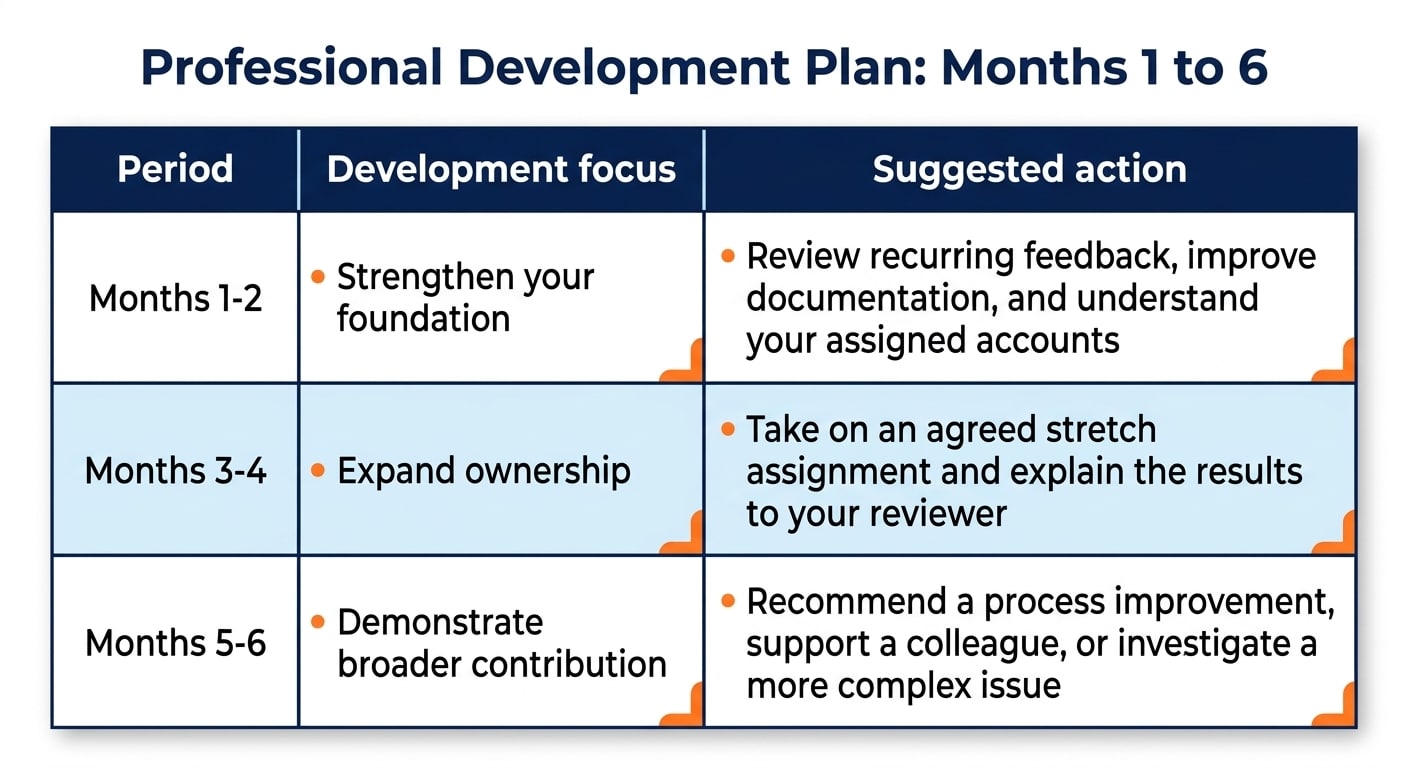
Track accomplishments as you go. Record the scope of the work, the problem addressed, and the result.
If you do not have a defensible numerical result, do not invent one. A clear description of improved ownership or a resolved accounting issue is more credible than an unsupported percentage.
Questions to Ask Before Accepting a Staff Accountant Job
An interview should help you assess the opportunity, not just prove that you can do the work.
Ask:
- Which accounts and close tasks will I own?
- Who reviews my work, and how is feedback delivered?
- What does the close calendar look like?
- What challenges would you want me to address first?
- How much of the role involves recurring processing versus investigation and analysis?
- What training is available?
- How have previous staff accountants developed within the team?
- What would strong performance look like after six months?
Listen for specific answers.
A company does not need a perfect accounting department to offer a good opportunity. But you should understand the expectations, the available support, and whether the experience aligns with your goals.
Build a Career Around More Than the Next Title
A staff accountant role can provide valuable experience in how a business records activity, maintains controls, and produces reliable financial information. The long-term value depends on what you learn to own—and how well you understand the work behind the numbers.
Whether you want to become a senior accountant, move toward management, or explore another finance specialty, evaluate your next step through that lens.
Oggi Talent connects accounting and finance professionals with career opportunities and offers guidance on navigating career moves. If you are considering your next accounting role in the Twin Cities or beyond, connect with Oggi Talent to discuss your experience, goals, and the kind of opportunity that would help you move forward.
Frequently Asked Questions About Staff Accountant Careers
What does a staff accountant do?
A staff accountant typically prepares journal entries, reconciles general ledger accounts, supports month-end close, and investigates discrepancies. Responsibilities vary by employer and industry. The work supports the accounting function’s broader responsibility for maintaining and examining accurate financial records.
What is the difference between a staff accountant and a senior accountant?
A senior accountant generally handles more complex work with greater independence. A staff accountant usually works within an assigned scope with more regular review. Senior roles may also involve coordinating close tasks, reviewing work, supporting colleagues, or recommending improvements. Titles vary, so compare actual responsibilities rather than assuming every employer uses the same hierarchy.
Do you need a CPA to become a staff accountant?
A CPA license is not required for every staff accountant job. A bachelor’s degree in accounting or a related field is a common entry qualification, and certification may strengthen prospects for certain roles. Review the requirements of the positions you want before deciding which credentials to pursue.
How much does a staff accountant make?
There is no single salary that applies to every staff accountant role. Compare compensation using location, experience, responsibilities, industry, and total benefits. Broad accountant-and-auditor salary figures include other specialties and experience levels, so don’t use them as a benchmark for staff accountant pay.
How do you move from staff accountant to senior accountant?
Build evidence that you can own more complex work, meet deadlines reliably, investigate discrepancies, and explain your reasoning clearly. Ask your manager for specific senior-level expectations and assignments that will help you demonstrate them. Use a development plan with review checkpoints rather than relying on tenure alone.
References
- Accountants and Auditors — U.S. Bureau of Labor Statistics
- Bookkeeping, Accounting, and Auditing Clerks — U.S. Bureau of Labor Statistics
- Senior Property Accountant — Oggi Talent
- The Finance and Accounting Talent Landscape in Minnesota — Oggi Talent
- Career Transitions in Finance: Navigating From Accountant to Financial Analyst — Oggi Talent